Why HVAC routing should be done before renovation
When planning an air conditioning installation, most people focus on the indoor and outdoor units. But between them runs a copper line set: two refrigerant pipes, a drain line, and an electrical cable. When and how these lines are routed determines the look of your space, the cost of the job, and the lifespan of the system.
What is an AC line set
The line set is the connection between the indoor and outdoor units of a split system. It includes:
- Two copper tubes (liquid and suction lines) for refrigerant circulation
- A condensate drain hose
- An inter-unit electrical cable
- Pipe insulation to prevent energy loss and condensation
Typical line length is 3 to 7 meters, though complex layouts can reach 15–20 meters. The longer the run and the more bends, the more critical proper installation becomes.
Why routing should be done before finishing
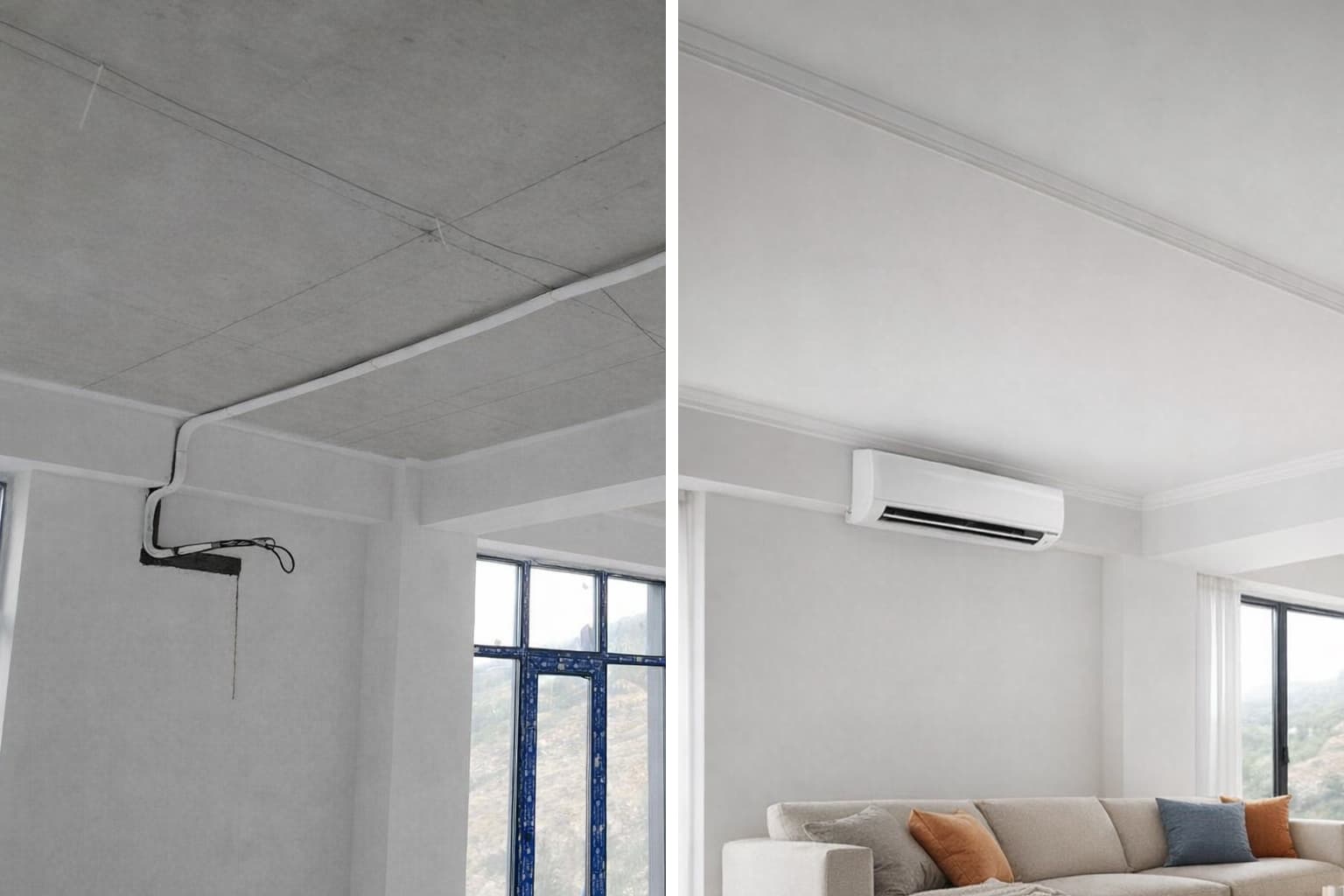
The rule is simple: anything hidden inside walls must be installed before plastering. Copper line sets are exactly this kind of utility. Here is what early routing gives you:
1. Concealed installation without trunking
Pipes are laid in wall chases and hidden under plaster. No visible tubes or plastic trunking — a clean interior with full design freedom.
2. Optimal path
With bare walls the engineer routes lines along the shortest path — no detours around furniture, cornices, or stretch ceilings. Shorter runs mean less pressure drop, better efficiency, and lower power bills.
3. Budget savings
Chasing bare concrete or brick is cheaper than cutting through finished surfaces. Post-renovation routing means cutting tiles, drywall, or plaster — then repairing. The cost difference can be 30–50% of the routing itself.
4. Proper drainage
The drain line needs a downward slope for gravity flow. Before finishing it is easy to set the right angle and route to a sewer connection or facade outlet. After renovation you often need a condensate pump — adding noise, maintenance, and a failure point.
5. Less dust and noise
Wall chasing means dust, vibration, and hammer drill noise. During rough works nobody minds. In a furnished apartment it becomes a serious disruption.
What happens if you route after renovation
Technically you can install an AC at any stage. But with finished walls your options are limited:
- Lines run along the wall surface in plastic trunking — visible and unattractive
- Longer path — routing around finishes, furniture, door frames
- Chasing finished walls damages surfaces and requires repair
- Condensate pump instead of gravity drain — extra cost and maintenance
- Higher total cost due to demolition and surface restoration
When exactly to route: renovation timeline
- Demolition — decide where units will go. Coordinate with designer.
- Electrical and plumbing rough-in — this is when line sets are installed. Chases are made alongside electrical conduits.
- Plastering — covers the line set. After this step, concealed installation requires demolition.
- Finishing — paint, tile, wallpaper. Lines are already inside the wall.
- Unit mounting — indoor and outdoor units are installed at the end or after renovation. Connecting to pre-laid lines takes 2–3 hours.
What affects the cost
Line set routing cost depends on several factors:
- Route length — longer runs need more material and labor
- Pipe diameter — depends on unit capacity (BTU). Residential 7–12K BTU uses 6/10 pipes, powerful 24–36K BTU requires 10/16 or 10/19
- Copper grade — standard or Halcor (premium, thicker walls, longer life)
- Route complexity — number of bends, wall penetrations, installation height
Approximate prices in Tbilisi range from 100 GEL per linear meter (standard 6/10 copper) to 200 GEL per meter (Halcor 10/19 for powerful systems). Price includes chasing, insulation, brazing, and mounting.
FAQ
Can I install lines now and buy the unit later?
Yes, this is standard practice. The line set is sealed and pressure-tested with nitrogen — it can wait months or even years. Just know the planned location and capacity so the right pipe diameter is used.
How many line sets for an apartment?
One per indoor unit. A two-bedroom apartment typically needs 2–3 sets: bedroom, living room, and optionally kitchen. For a multi-split system all lines lead to one outdoor unit.
What if I have not chosen an AC brand yet?
An engineer calculates required capacity based on room size and orientation. Lines are sized accordingly. 90% of residential units use the same pipe diameters — you are not locked into any brand.
Checklist: preparing for line routing
- Determine the number and placement of indoor units
- Choose outdoor unit location (balcony, facade, rooftop)
- Coordinate routes with your designer and electrician
- Call an HVAC engineer before plastering begins
- Plan a dedicated electrical circuit for each AC unit
- Decide drainage destination — sewer or facade
Summary
Line routing accounts for 20–30% of the total AC system cost. But it determines whether the installation looks clean or hides behind trunking. Route your lines during rough works — it is cheaper, cleaner, and more reliable.
If your renovation is underway or in the planning stage, contact us. An engineer will visit, measure the routes, and prepare a routing plan before finishing works begin.